

Reaction Kinetics: Experiments, Network Analysis, and Modeling
Project Leader: Hannsjörg Freund
Researchers: Marion Börnhorst, Maximilian Gstettenbauer, David Kellermann, Elodia Morales
Rigorous, model-based process optimization requires a precise understanding of the reaction system, which typically consists of a network of multiple subreactions. The insights gained can be used to redesign or further develop processes with regard to efficiency, safety, sustainability, and cost-effectiveness. In this context, the design and optimization of the chemical reactor—as the core element of the process—are of particular interest. This design is generally based on balance equations that incorporate thermodynamic approaches and kinetic models for reactions as well as mass and heat transfer. A reaction kinetics model refers to the mathematical description of the reaction mechanism of each subreaction occurring in the reaction system as a function of the respective components involved.
Developing a reaction kinetics model first requires measurements in a laboratory reactor under well-defined conditions. The measurements are organized using statistical experimental design (“Design of Experiments,” DoE) so that they can be carried out with as few experiments as possible, while still reflecting the sensitivity of the system. Based on the measured values obtained, mathematical approaches are selected during the kinetic modeling step; these are based on mechanistic assumptions (of varying levels of detail) and exhibit trends that are qualitatively similar to the measured values. These approaches include, on the one hand, state variables such as concentration or temperature, and on the other hand, model parameters to be adjusted—such as activation energy or collision factor—whose variation allows the results of the mathematical description to be approximated to the measured values. Through a statistical evaluation of the fitting results (confidence intervals, correlation coefficients, residuals), the approach that provides sufficiently accurate and statistically reliable values for each subreaction of a reaction network can be identified. The result of the kinetic modeling is therefore a fully parameterized mathematical model that describes every partial reaction occurring in the reaction system.

The department conducts reaction kinetics measurements, the associated reaction network analysis, and reaction kinetics modeling. Several dedicated laboratory reactors are available for this purpose; these allow for the adjustment and control of a wide variety of parameters and can be operated either discontinuously and/or continuously. The department has extensive expertise in the development and construction of new, as well as the adaptation of existing, custom-designed experimental setups. The setup of the laboratory systems consists of a section for dosing the reactants, the laboratory reactor, and high-resolution analytical equipment, and can be adapted to the specific requirements of the reaction in order to generate the most meaningful measurement data possible. In particular, gradient-free recirculating reactors, known as Berty reactors, are used for this purpose. In addition, studies can be conducted in tubular reactors up to the meter scale to analyze effects expected in industrial-scale reactors, such as non-ideal flow distribution or mixing. The individual setups are designed for either single-phase or multiphase reaction systems. Various state-of-the-art software tools and solvers are available for reaction kinetics modeling.
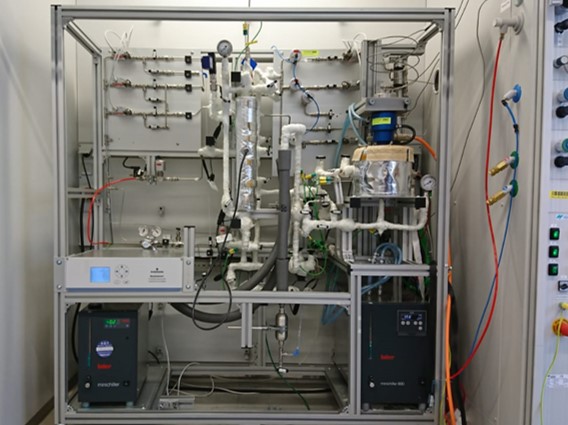
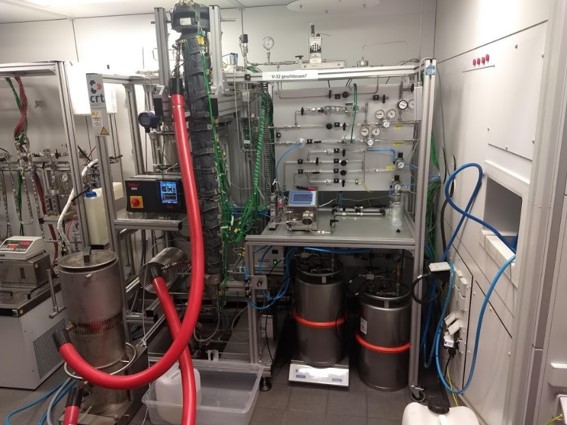
Through our extensive research in the field of reaction kinetics modeling, we have developed a wide variety of approaches and methods that can be used to address even complex problems when dealing with very large reaction networks. The complexity of process engineering studies can stem from various causes, and accordingly, approaches tailored to the specific problem must be employed. In this regard, our department has built up extensive expertise and know-how over the past few years.
A common challenge is that the reaction network under investigation consists of a very large number of reactions, accompanied by a very large number of chemical species. In such cases, the network must be reduced to only those reactions that are truly necessary to describe the system within the relevant operating range. This can be achieved through targeted experiments combined with a sophisticated analysis strategy, as demonstrated in our research group, for example, for the reaction network of olefin conversion reactions on an H-ZSM 5 catalyst.

Another challenge lies in choosing the appropriate level of modeling detail. In this context, as part of a subproject within the DFG-funded Priority Program 2080 “Catalysts and Reactors under Dynamic Operating Conditions for Energy Storage and Conversion,” we are working on the development of a new class of reaction kinetics approaches. The aim here is to dispense with the assumption—common in formal kinetic approaches—of a rate-limiting substep and, consequently, the equilibrium of all other subreactions. This is of interest in the investigated reaction system of dynamic methanation in the context of chemical energy storage, since during dynamic operation the sorption processes are not necessarily in equilibrium and, in addition to gas-phase dynamics, there are dynamics of catalyst surface occupancy. However, an extremely detailed microkinetic description is deliberately avoided here, since the kinetic model to be developed is subsequently intended for use in the context of model-based optimization and must therefore remain numerically manageable.

In the field of industrial applications involving large-scale syntheses, it is often the case that no measurement data from laboratory reactors under well-defined, isothermal conditions is available, or that such studies are omitted for reasons of time and cost. If reaction kinetics are to be determined directly from integral experimental data using the technical catalyst in a polytropic fixed-bed reactor on a meter scale, a well-thought-out strategy must be applied for both the experiments and the evaluation procedure. Using the example of the partial oxidation of propene to acrolein, our research group has successfully demonstrated how reaction kinetics modeling and parameter estimation can be performed based on such measurement data under non-isothermal conditions. The basic idea behind the methodological approach we developed is to exploit the sensitivities of the measurement data in the various zones of the reactor.