

Model-Based Design of Optimal Reactors
Principal Investigator: Hannsjörg Freund
Researchers: Elodia Morales, Lutz Vogel-Lackenberg, Mathias Waldner
One of the main research focuses of the Chair of “Reaction Engineering and Catalysis” is the development of optimal catalytic reactors for implementing highly efficient chemical processes. The goal of this optimization is to achieve the highest possible yield of the desired product while minimizing energy and resource consumption. To achieve this, we utilize the Multi-Level Reactor Design (MLRD) concept developed by our group. This concept can be divided into four levels.

A prerequisite for model-based reactor design using MLRD is the description of the reactions taking place through a reaction kinetics model. Since this is a crucial first step, a separate area of research (reaction kinetics: experiments, network analysis, and modeling) is dedicated to this topic. Once a model with an adequate level of detail has been established to describe the actual reaction network, the process of identifying and analyzing the ideal reaction pathway in detail begins (Level 1).
To make it easier to understand, the MLRD concept will be illustrated using a simple, concrete example: the oxidation of sulfur dioxide (SO₂) to sulfur trioxide (SO₃). This reaction is a crucial step in the production of sulfuric acid using the double-contact process. At Level 1, the ideal reaction path up to a desired conversion is considered. The goal here is to minimize the reaction time required for this, so the aim is to achieve the highest possible reaction rate. According to Arrhenius, a high temperature is required for this. However, since the oxidation of SO₂ is an exothermic equilibrium reaction, the temperature must not be set too high to avoid limitations caused by an unfavorable equilibrium state. Thus, there is an optimal temperature at which the reaction should be carried out. This optimal reaction pathway is shown in the following diagram.
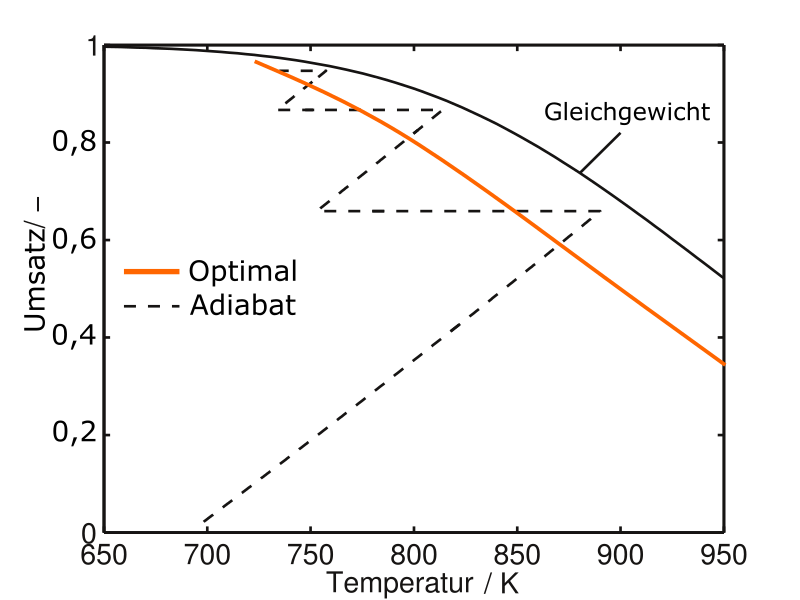
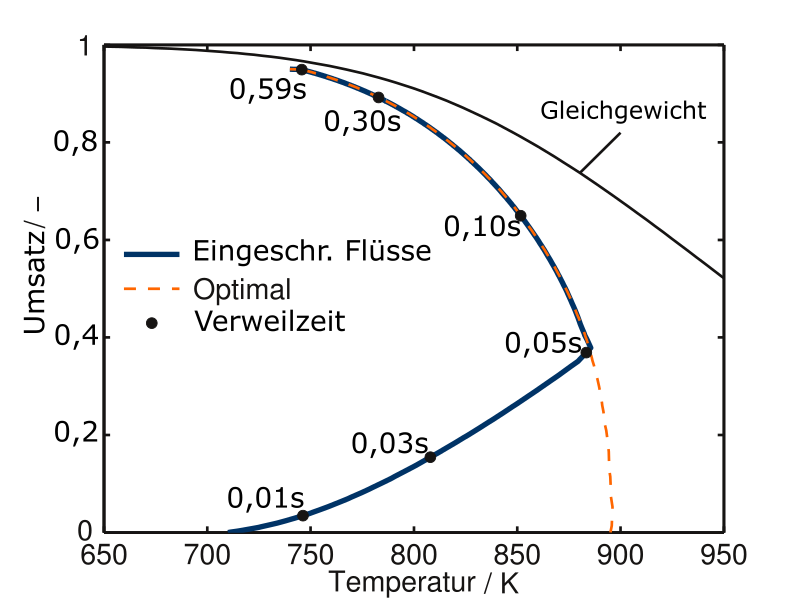
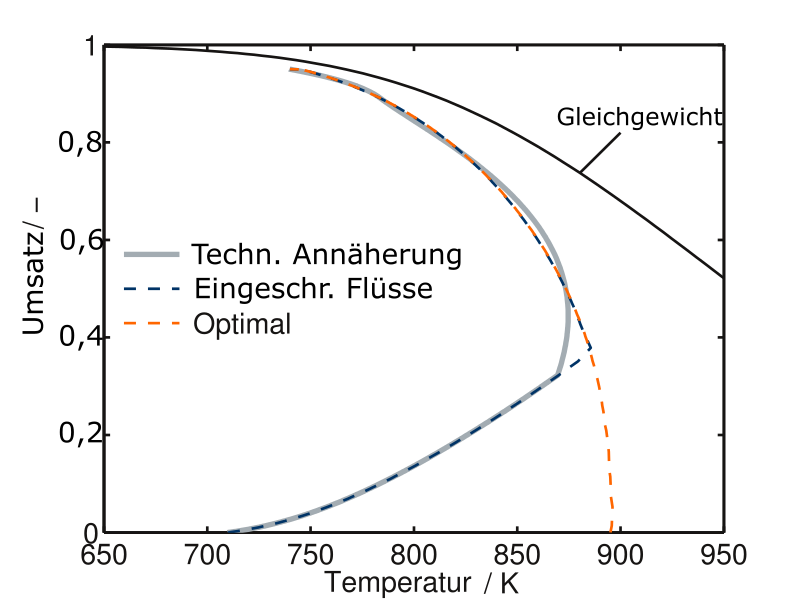
In addition to the ideal reaction path, the diagram for Level 1 shows the current state of the art in adiabatic tray reactors. The optimal reaction path is determined based on the assumption of unrestricted heat and mass transfer within the reactor. In reality, however, mass transfer limitations occur - particularly at high temperatures - which are taken into account at Level 2 of the MLRD methodology. At this stage, initial idealized reactor concepts are also incorporated into the analysis. The resulting reaction pathway deviates significantly from the optimal reaction pathway at high temperatures and low conversion rates.
In the final step (Level 3), the technical feasibility of the developed optimal reactor concept is determined. Here, the heat and mass transfer processes in the reactor - which, in reality, proceed at only finite rates due to technical constraints - as well as optimized temperature control play a decisive role. At this stage, various operating concepts are examined, and technically feasible control strategies are considered. The result is the optimal reaction control within the limits of technical feasibility.
The simple example presented here serves merely as an illustrative explanation. The MLRD methodology has been expanded over the past few years to include many substantial aspects and application possibilities. Thus, MLRD is equally applicable to highly complex reaction networks with up to approximately 70 reactions. Especially for such complex systems, the optimal solution is often highly counterintuitive and can no longer be predicted using heuristics.
Other successful applications of the MLRD methodology:
In addition, the optimization can also be performed using two-dimensional reactor models, provided that this is required due to strong radial gradients or is necessary for a better understanding of the results. Life-cycle optimization has also already been performed, in which the optimization takes into account the entire service life of a catalyst that deactivates over time. Conversely, this approach can also be used to optimize the service life of the catalyst and to compare different catalysts in terms of their service life.
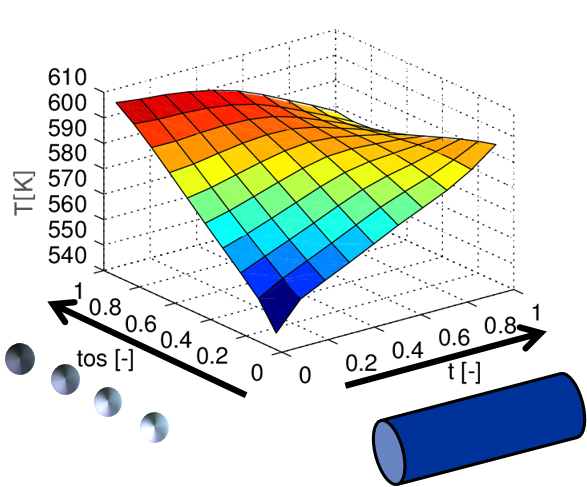
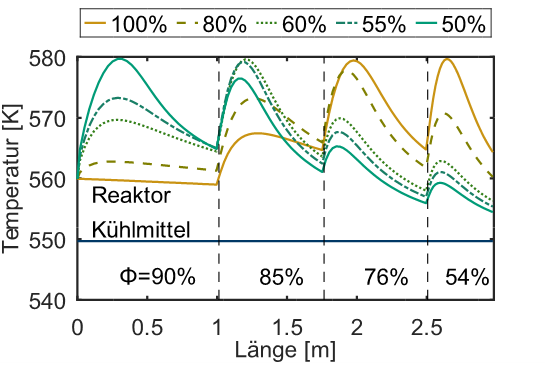
Other successful applications of the MLRD methodology include the optimization of dynamically operated reactors, optimization under uncertainty, multi-objective optimization, the incorporation of rigorous diffusion models, and, in this context, the generalized consideration of the catalyst pellet for the integrated optimal design of the entire catalyst-reactor system.

An additional extension involves the treatment of multiphase systems. The simpler case of rapid mass transfer between the phases can be considered analogously to the single-phase case (where the second phase serves merely as a reservoir). If, on the other hand, mass transfer limitations exist in the system, both phases must be explicitly taken into account in the modeling. In this context, the applicability and potential of the MLRD methodology for optimizing reactive separation devices were impressively demonstrated using the example of optimizing a chemical absorber.
Further Reading
Fischer, K.L.; Freund, H.: Intensification of Load-Flexible Fixed-Bed Reactors through Optimal Design of Staged Reactor Setups, Chem. Eng. Process. 159 (2021) 108183; https://doi.org/10.1016/j.cep.2020.108183
Fischer, K.L.; Freund, H.: On the Optimal Design of Load-Flexible Fixed-Bed Reactors: Integration of Dynamics into the Design Problem, Chem. Eng. J. 393 (2020) 124722; https://doi.org/10.1016/j.cej.2020.124722
Maußner, J.; Freund, H.: Multi-Objective Reactor Design Under Uncertainty: A Decomposition Approach Based on Cubature Rules, Chem. Eng. Sci. 212 (2020) 115304; http://dx.doi.org/10.1016/j.ces.2019.115304
Freund, H.; Maußner, J.; Kaiser, M.; Xie, M.: Process Intensification by Model-Based Design of Tailor-Made Reactors, Curr. Opin. Chem. Eng. 26 (2019) 46–57; https://doi.org/10.1016/j.coche.2019.08.003
Maußner, J.; Dreiser, C.; Wachsen, O.; Freund, H.: Systematic Model-Based Design of Tolerant Chemical Reactors, J. Adv. Manuf. Process. 1(3) (2019) 1–20; https://doi.org/10.1002/amp2.10024
Kaiser, M.; Freund, H.: A Multimodular Pseudoheterogeneous Model Framework for Optimal Design of Catalytic Reactors Exemplified by Methanol Synthesis, Chem. Eng. Sci. 206 (2019) 401–423; https://doi.org/10.1016/j.ces.2019.04.036
Pietschak, A.; Kaiser, M.; Freund, H.: Tailored Catalyst Particle Specifications for Improved Fixed-Bed Transport Characteristics: A Shortcut Method for Model-Based Reactor Design, Chem. Eng. Res. Des. 137 (2018) 60–74; https://doi.org/10.1016/j.cherd.2018.06.043
Xie, M.; Freund, H.: Rigorous Design of Multiphase Reactors: Identification of Optimal Conditions for Mass Transfer Limited Reactions, Chem. Eng. Process. 124 (2018) 174–185; https://doi.org/10.1016/j.cep.2017.11.012
Xie, M.; Freund, H.: Optimal Reactor Design and Operation Taking Catalyst Deactivation into Account, Chem. Eng. Sci. 175 (2018) 405–415; https://doi.org/10.1016/j.ces.2017.10.010
Peschel, A.; Freund, H.; Sundmacher, K.: Methodology for the Design of Optimal Chemical Reactors Based on the Concept of Elementary Process Functions, Ind. Eng. Chem. Res. 49(21) (2010) 10535–10548; https://doi.org/10.1021/ie100476q
Freund, H.; Sundmacher, K.: Towards a Methodology for the Systematic Analysis and Design of Efficient Chemical Processes – Part 1: From Unit Operations to Elementary Process Functions, Chem. Eng. Process. 47(12) (2008) 2051–2060; https://doi.org/10.1016/j.cep.2008.07.011